Weave
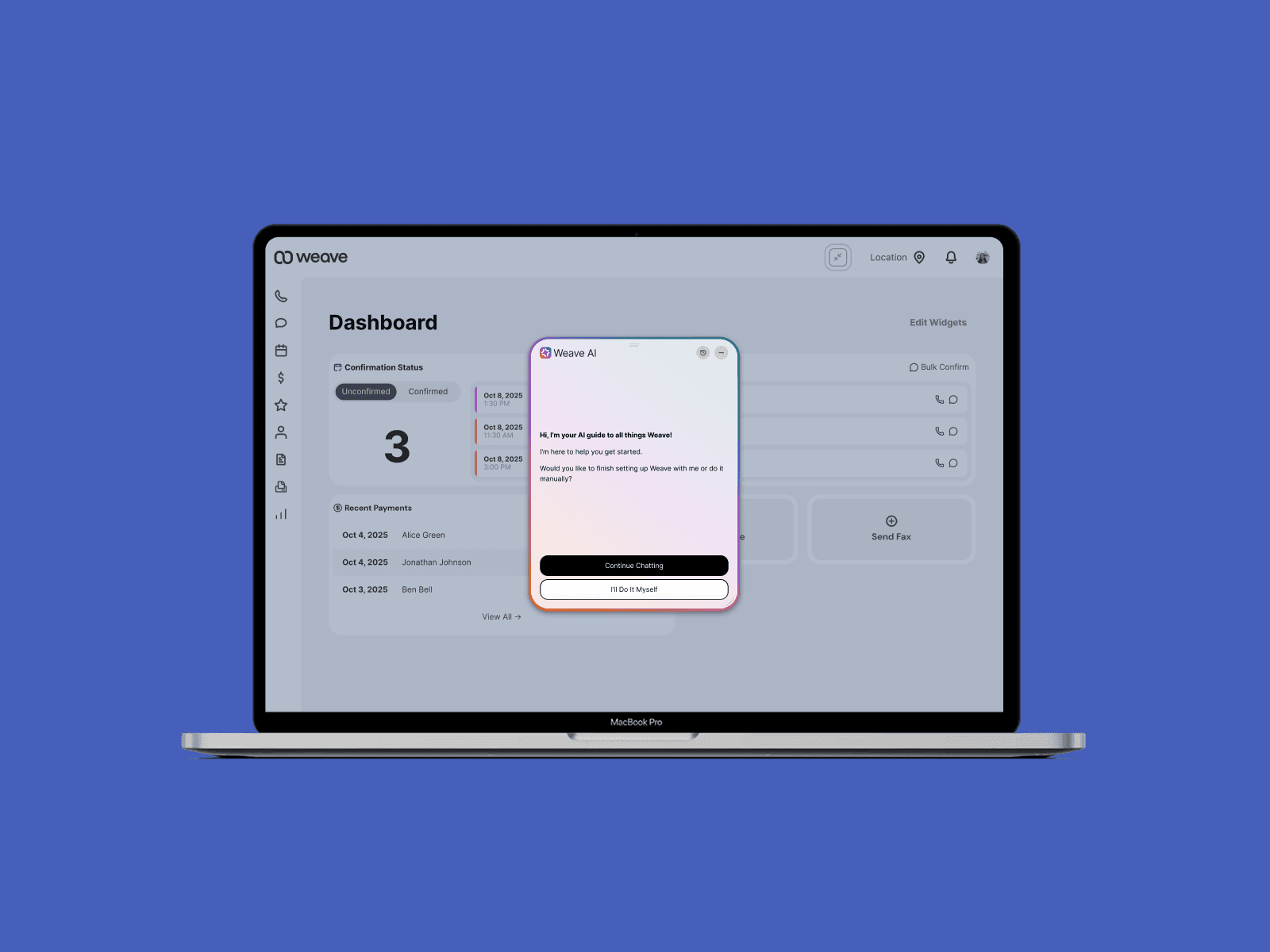
Weave AI
Overview
Weave is the leading software company for dental and veterinary clinics, offering tools for communication, payment processing, scheduling, document management, and marketing.
Defined and aligned a long-term AI platform vision across Product and Engineering, and designed the onboarding assistant as the first implementation of that system.
Process
The Problem
New customers were struggling to complete required setup tasks during onboarding. This slowed time to value and increased reliance on onboarding specialists and account executives.
At the same time, AI experiments were emerging in isolated product areas. These efforts were scoped to individual features and lacked a unifying platform vision. Without convergence, this risked duplicated infrastructure, inconsistent interaction models, and long-term technical debt.
I saw two related problems:
Onboarding friction
Fragmented AI strategy
The Insight
Early in exploration, I assumed AI work in Messaging would evolve into a platform-level assistant. Feedback revealed that this was not the long-term plan.
That changed the direction of the project.
Instead of designing an onboarding chatbot, I reframed the opportunity:
If AI is going to exist across the product it needs to be designed as infrastructure, not a collection of features. We have to establish a North Star to guide early designs.
Onboarding became the entry point, not the end state.
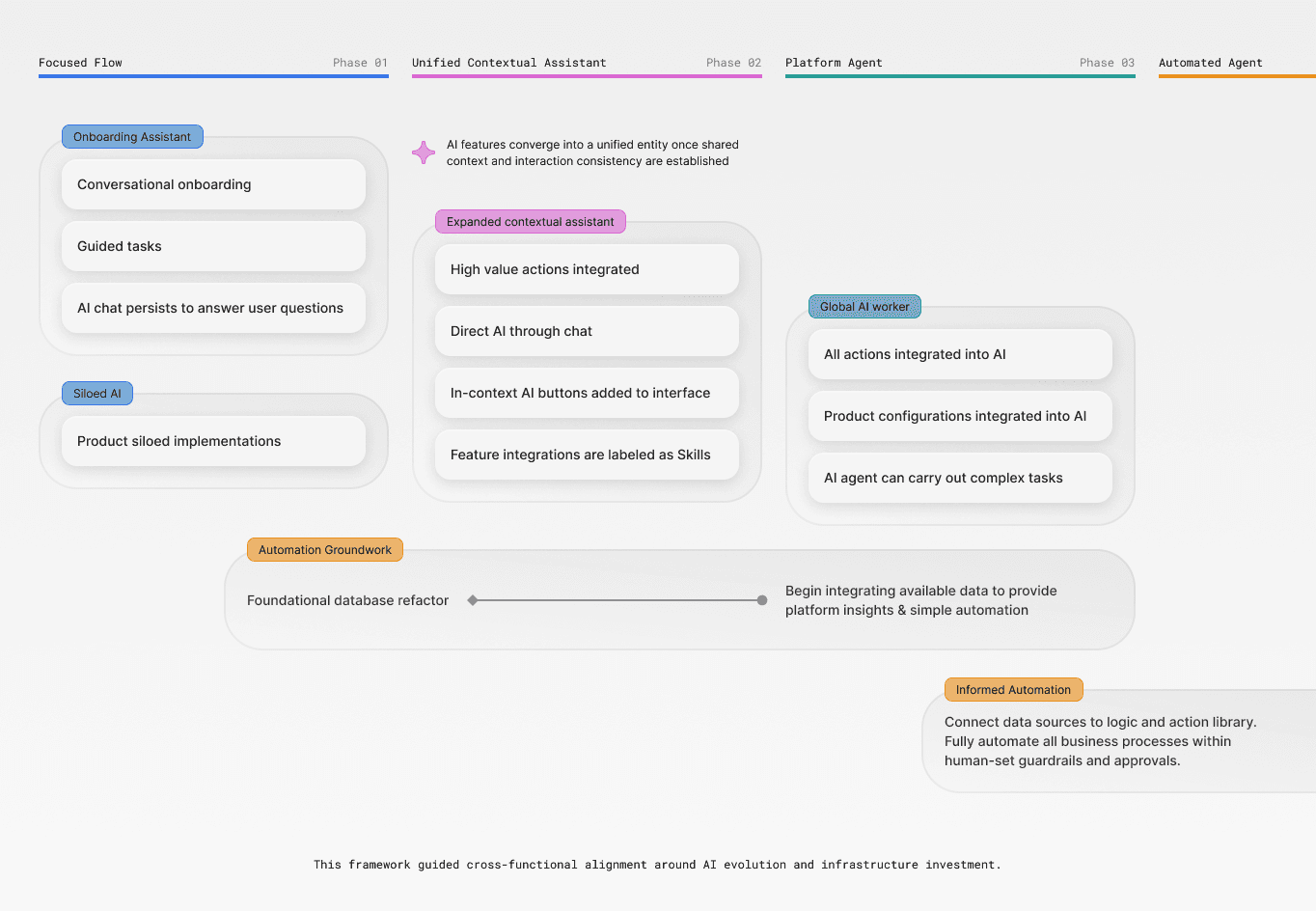
Defining the Platform Vision
I created a long-term AI vision that included:
High-value use cases across onboarding, messaging, payments, and settings
A unified interaction model
A clean evolution path from onboarding assistant to global AI worker
Design principles for embedding AI naturally within workflows
Shared context and memory layer across AI touchpoints
This vision clarified:
What we were building now
What we were enabling later
What infrastructure would be required
Driving Alignment
To move beyond concept, I led conversations across:
Product leadership
Engineering leadership
ML team
Integrations team
These discussions focused on:
Data access requirements
Model ownership
Integration architecture
Escalation patterns to human support
State persistence
The goal was alignment before execution. This shifted the conversation from shipping an onboarding feature to sequencing platform capabilities intentionally.
Designing the Onboarding Assistant (MVP)
With alignment in place, I designed the AI Onboarding Assistant as Phase 1 of the broader system. The assistant was intentionally scoped to validate both the interaction model and the underlying AI infrastructure required for broader expansion.
Key decisions:
Contextual entry points within onboarding tasks
A persistent but non-intrusive assistant
Clear escalation to human support
Reusable interaction patterns
State-based visual system
I named and branded the assistant, designing an icon that could communicate:
Idle
Listening
Processing
Responding
Error states
I also created motion studies to define how the assistant would behave.
The visual system was intentionally extensible so it could scale into a global assistant without redesign.
Outcome
Product Outcome
Engineering built the foundational AI onboarding assistant based on the defined system architecture.
The assistant was introduced to a limited user cohort, establishing:
Core AI infrastructure foundations (context persistence, escalation patterns, and reusable interaction contracts)
Reusable interaction patterns
Brand presence for future AI expansion
Alignment around long-term AI strategy
Modeled Impact
While the assistant was early-stage at the time of my departure, projected impact was modeled based on onboarding baselines and industry benchmarks.
Assumptions:
40–60% average SaaS onboarding completion rate
10–25% improvement from guided assistance
15–30% reduction in human-assisted onboarding requests
Even conservative estimates suggested:
Faster time to value
Reduced onboarding specialist load
Lower support costs
Increased activation rates
Organizational Outcome
Beyond the onboarding feature itself, this project:
Unified fragmented AI efforts under a shared direction
Established a platform-level AI roadmap with defined capability gates
Created cross-functional alignment across Product, Engineering, and ML
Reduced long-term architectural risk and duplicate investment
Positioned AI as durable product infrastructure rather than isolated experimentation
The onboarding assistant became the foundation for a broader AI strategy.
*Copyrights for these designs belong to
Weave Communications, Inc